

TERRITORY
Vineyard health monitoring and precision spraying at Château de Saint Pey
The goal is to intervene only where necessary, at the right time and in the right dose, while securing production potential and limiting environmental impact.
FRANCE
AREA TO BE DIGITISED
Production Processes
SUBSECTOR #1
Agriculture
SUBSECTOR #2
Vineyard winemaking
CROP PRODUCTION SYSTEM 1, 2, 3
Rainfed
Organic
Open-field
TECHNOLOGY
Big Data and Data Analytics, Machine Learning, Location based technologies/systems
DIGITAL SOLUTION CATEGORY
Precision farming
STAKEHOLDERS
Individual farmers
IMPACT
Productivity
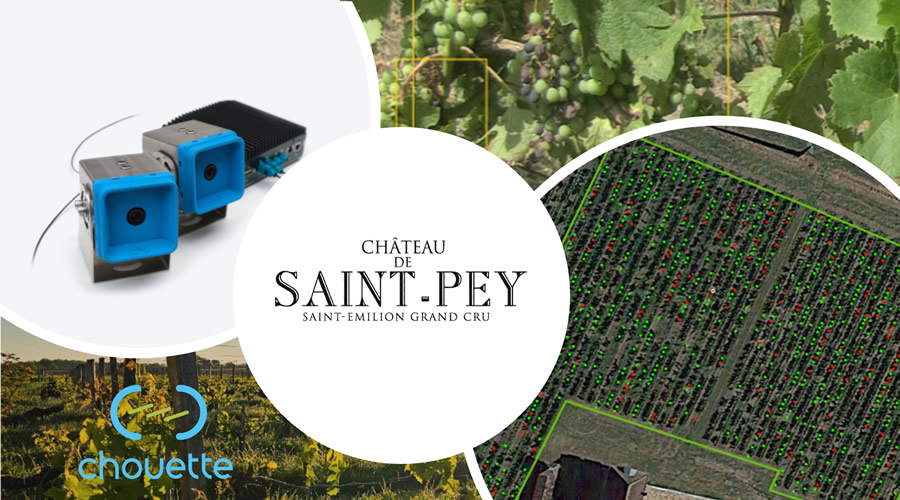
Château de Saint Pey, a wine estate located in Saint-Émilion, now covers 26 hectares, mainly planted with Merlot (90%) and Cabernet Franc (10%).
Since its acquisition in 2011, the estate has gradually restructured and expanded its vineyard to increase its quality potential, growing from 16 hectares to its current size. This dynamic development has generated increased needs for detailed characterization of the plots, rigorous health monitoring, and efficient work organization to intervene quickly when necessary. In 2018 and 2019, the estate suffered severe mildew pressure, resulting in yield losses for two consecutive years. At the same time, the château chose to shift its viticulture towards predominantly organic practices, limiting the use of conventional products while maintaining the possibility of targeted intervention in the event of severe health pressures. In this complex context—combining economic, health, and environmental issues—Château de Saint Pey has adopted a precision viticulture approach, integrating digital technologies and artificial intelligence to detect diseases early, assess the risk on each plot, and optimize phytosanitary treatments. The goal is to intervene only where necessary, at the right time and in the right dose, while securing production potential and limiting environmental impact.
Farm challenges
Since its acquisition in 2011, Château de Saint Pey has undergone significant structural changes with the gradual expansion of its vineyard from 16 to 26 hectares and a major restructuring of its plots. This dynamic has generated several challenges:
- Detailed characterization and monitoring of a constantly evolving vineyard.
- Increased health monitoring and responsiveness requirements.
- Organization and optimization of the work of a small team (3 tractor drivers).
- High pressure from mildew in 2018 and 2019, leading to significant yield losses.
- Transition to a predominantly organic production method, with very limited use of conventional products.
- Reduction and better positioning of inputs (copper, sulfur), while maintaining a target yield of 42 to 48 hl/ha.
Securing the yield and therefore the economic structure of the farm, as well as reducing these inputs, are the two central issues that prompted the farm to integrate this technology.
Assistance / Boost program
The project was led directly by the estate, under the impetus of the vineyard manager, as part of a strategic investment in innovation.
It received support from the Vititech program in the Nouvelle Aquitaine region, a funding scheme to support the adoption of robotic and digital solutions in viticulture that promote agroecological transition.
The integration of the digital solution was based on:
- Technical and agronomic support for data interpretation.
- A gradual increase in the skills of the viticulture teams.
- A redesigned internal organization to integrate data into operational decision-making.
This approach is part of a commitment to continuously improve practices and anticipate health risks.
Innovative features of the initiative / solution
To address health protection and yield security issues, Château Saint de Pey has deployed a precision viticulture ecosystem combining onboard sensors, multispectral imaging, and artificial intelligence. Each tractor on the estate is equipped with multispectral cameras that automatically capture images of all the rows traveled, developed by the company Chouette, and RTK GPS offering centimeter-level accuracy. The data collected is analyzed using artificial intelligence coupled with agronomic models. This analysis enables early detection of disease symptoms such as mildew and identification of symptomatic vines. This allows the generation of maps to visualize disease outbreaks via an application and classify plots according to their level of risk. Data processing takes place within 24 hours of the image being taken, providing teams with detailed maps showing the health pressure on each row and personalized treatment recommendations. This information complements the field observations of tractor drivers and the crop manager, enabling the team to plan targeted and effective interventions. The recommendations provided can be adapted according to a risk level defined by the farmer. It is both a real-time monitoring solution and a decision-making tool.
For the spraying phase, the estate has equipped its fleet of tractors with ISOBUS consoles and sprayers with recovery panels, allowing the flow rate to be adjusted and the nozzles to be opened or closed according to the final recommendation maps. This approach ensures that treatments are only applied where necessary, at the optimal dose and at the right time, maximizing efficiency while reducing the use of plant protection products.
The digital solution deployed at Château de Saint Pey thus constitutes a complete decision-making chain, from automated data collection in the field to the precise execution of interventions. It takes between two and three days between the image being taken and the tractor driver taking action.
Results obtanied
The integration of this digital solution has enabled Château de Saint Pey to achieve concrete results:
- Stabilization of yields after several years of health-related losses.
- Securing of plots historically susceptible to mildew.
- Optimization of phytosanitary inputs and IFT.
- Improvement in plot homogeneity and harvest quality potential.
- Ability to map the vineyard and take action within 2 to 3 days.
- Improved responsiveness of teams to rapidly changing disease pressure.
- Involvement of tractor drivers in decision-making.
- Strengthening of data-driven decision-making, complementing field observation.
Lessons learned
This use case highlights several key lessons:
- At a planting density of approximately 6,500 plants/ha, an onboard camera can effectively cover between 8 and 12 hectares for rapid intervention within two to three days.
- Reducing inputs alone is not enough to make the technological investment profitable; the real return on investment comes from securing yields and avoiding crop losses due to health risks.
- The complementarity between digital data and human expertise is essential.
- An appropriate internal organization is a determining factor in taking full advantage of precision technologies.
Contact
- Website: https://www.chouette.vision

