

TERRITORY
Digitalisation of health protection
This solution makes it possible to better anticipate phytosanitary risks, adjust treatment dates and doses, and reduce the treatment frequency index (TFI).
FRANCE
AREA TO BE DIGITISED
Production Processes
SUBSECTOR #1
Agriculture
SUBSECTOR #2
Vineyard winemaking
CROP PRODUCTION SYSTEM 1, 2, 3
Rainfed
Conventional
Open-field
TECHNOLOGY
Big Data and Data Analytics, IoT
DIGITAL SOLUTION CATEGORY
Production process management
STAKEHOLDERS
Individual farmers
IMPACT
Productivity
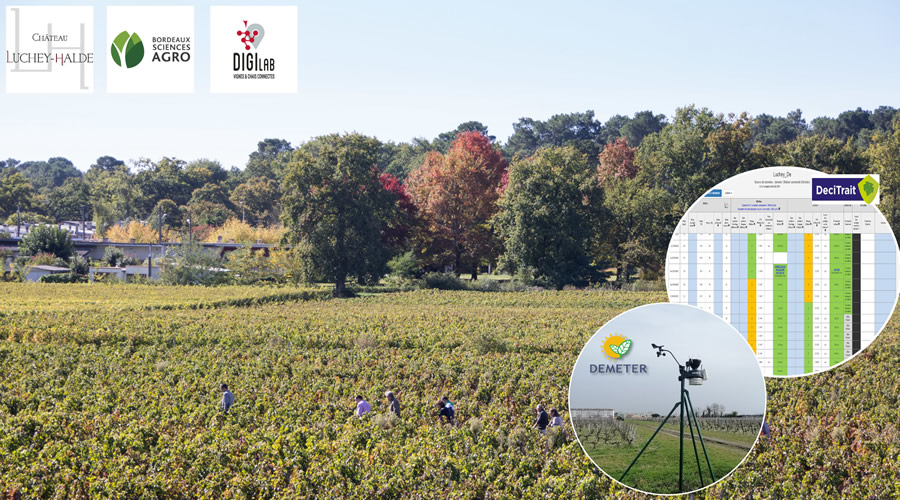
Château Luchey Halde is a 21-hectare wine estate located in the Pessac Léognan appellation and owned by Bordeaux Sciences Agro, an agricultural education and research institution. The vineyard is managed using ‘sustainable’ viticulture methods and is committed to an agroecological approach. Since 2018, Château Luchey Halde has been hosting ‘large-scale’ experimentation and demonstration activities involving digital technologies in the vineyard as part of the “Digilab” initiative. ‘Digilab’ is an open innovation platform that tests and provides better information on digital and robotic technologies based on the needs and expectations expressed by stakeholders in the sector.
As the host winery, Château Luchey Halde and its operational production teams have had the opportunity to test many new technologies. This document details a specific case study for vineyard protection and pesticide reduction, focusing on an ecosystem of digital solutions that, after experimentation, has been routinely adopted by the château. It presents the adoption of a digital ecosystem combining a connected weather station and the Décitrait decision support tool (OAD) in order to optimise the health protection of the vineyard. This solution makes it possible to better anticipate phytosanitary risks, adjust treatment dates and doses, and reduce the treatment frequency index (TFI), while ensuring crop safety and meeting the estate’s environmental and social requirements. In addition, when combined with traceability software, the tool facilitates regulatory traceability of phytosanitary practices.
Farm challenges
Château Luchey Halde is an urban vineyard, located in the heart of the Bordeaux metropolitan area, open to the public and with a long-standing commitment to environmental (ISO 14001, HVE) and CSR (Bordeaux Cultivons Demain) initiatives.
As such, the château has an exemplary policy regarding environmental protection and dialogue with local residents, and aims to reduce its inputs, particularly the use of pesticides.
In this context, the estate faced several major challenges:
- Reducing pesticide use and the Treatment Frequency Index (TFI), in line with its certifications and its role as an educational showcase.
- Ensuring effective disease protection against downy mildew and powdery mildew, without compromising harvest security.
- Adapting treatments to the actual conditions of the plots (climatic variability, disease pressure).
- Justifying treatment decisions to stakeholders (local residents, institutions, certification bodies).
- Improving work organization and the traceability of plant protection practices. Luchey Halde consists of a small team, so good resource management is of great importance.
The château’s teams sought to acquire a tool:
- Enabling them to assess disease risks.
- Precisely indicating the optimal time for treatment.
- Allowing them to adjust the dose of plant protection product based on the vine’s leaf volume.
Assistance / Boost program
As a pilot site for Digilab, an open innovation platform supported by Bordeaux Sciences Agro, the project benefited from the technical and scientific expertise of BSA’s digital department, which provided:
- Implementation and monitoring of the experiment.
- Data collection and analysis.
- Support for the château’s teams in adopting the tools.
Digilab is a program funded by the PIA VitiREV initiative, led by the Nouvelle-Aquitaine region. The project was therefore indirectly supported by this program, which aims to develop innovative technical tools for transforming climate adaptation and ecological transition practices.
Innovative features of the initiative / solution
The solution deployed is based on a digital ecosystem dedicated to protecting vineyards, combining:
- A connected weather station (Davis station, Demeter network services) providing accurate local data (temperature, precipitation, humidity, hygrometry).
- The Décitrait decision support tool, developed by the IFV, fed by this geolocated meteorological data.
Décitrait is a decision support tool (DST) that monitors the level of infection by diseases (mildew and powdery mildew) affecting vineyard plots.
By feeding the Décitrait model with local meteorological data from its weather station (temperature, precipitation, humidity and hygrometry), Château Luchey Halde received advice tailored to the specific conditions of its plots.
The tool offers the following features:
- Short-term modelling and forecasting of downy mildew and powdery mildew risks.
- Suggestions for optimal intervention dates: based on disease risks and agrometeorological conditions (cumulative rainfall, forecasts, contaminating rainfall, leaf humidity, product persistence and leaching, etc).
- Calculation of product application doses (linked to Optidose).
- Simplified traceability thanks to treatment recording.
- Simple exports in Excel table format.
- Calculation of annual balances (IFT, share of biocontrol, product costs, etc).
The tool is offered with an API that allows for easy interfacing with other tools. Since 2025, an export to traceability software has also been used.
The estate uses the tool throughout the season in desktop mode.
Results obtanied
The use of the local weather station + the decision-making tool since 2021 has helped to:
- Control the number and frequency of treatments. The overall IFT (Treatment Frequency Indicator at farm level) for the château is below the regional IFT average, even in years with high disease pressure.
- Control the amount of copper used: thanks to the tool, the manager monitors the amount of copper used by editing interim reports throughout the season.
- Ensure satisfactory plant protection.
- Give the farm manager confidence in his decision-making by enabling him to monitor risk on a daily basis.
- Ensure the traceability of treatments and produce the reports required by regulations and various certifications.
Lessons learned
The key factors that led to the adoption of the tool:
- Ease of use. The OAD was quickly adopted because it is a very simple too : once the settings have been configured, only a few pieces of information related to the treatments need to be entered into a table. Although it is not perfect (the model does not include all the variables that influence risk), this tool is therefore preferred to other tools available on the farm, which are more comprehensive but much more complex to use.
- Flexibility of use: the farmer is free to follow the recommendations or not; he can consult interim reports during the season; he can use the tool on a daily basis to monitor risks but adapt the frequency of data entry according to their availability.
- Interoperability. The tool can be fed with input from most weather stations and also allows output to be exported to other traceability solutions. This avoids double entry.
- Ease of quickly perceiving added value. The combination of weather station + OAD covers an area that is truly critical for operations (vineyard protection). As the château is very committed to controlling its environmental impact, the operator is particularly motivated to use these solutions. Furthermore, the perceived usefulness also stems from the fact that the system can perform various functions: risk management and regulatory traceability. The time spent using the solution is therefore considered worthwhile.

